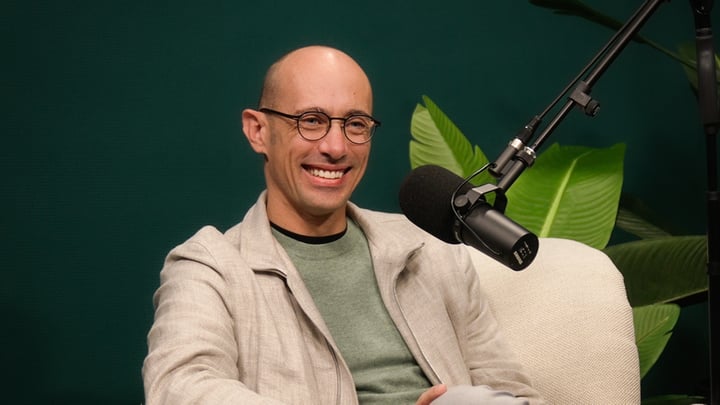
Andrew Ross Sorkin does the work of about five people. He founded and writes the DealBook newsletter for the New York Times. He hosts Squawk Box on CNBC every morning at 6am. He runs the DealBook Summit, which has become the premier annual interview event across business, policy, and technology. He co-created the TV show Billions. He wrote the definitive account of the 2008 financial crisis, "Too Big to Fail", and now he's written "1929," a 600-page epic about the greatest crash in Wall Street history. So how does he actually do all of this?
Today we sit down with Andrew to answer exactly that question. We dive into his philosophy on interviewing, his start as a teenage freelancer at the New York Times, how he built DealBook from a daily column into a media empire, and his actual daily routine that somehow fits all of this into 24 hours!
Tobi is one of the most thoughtful people in the technology industry. He's also one of the very few people who started as a programmer -- just trying to solve his own problem -- and still runs his company as CEO today even as it approaches a $200B market cap. Tobi has done this in two big ways: first, a willingness throw away his past beliefs in the face of new data, growing into the leader the company needed. And second, by remaining a close observer (and participant!) in how new technology emerges that changes what is possible.
Today we talk with him about both. The first half of the episode is about what has changed for him in the AI era. How he spends his time with AI throughout the day, how he thinks about what AI unlocks philosophically, and what he thinks the impact will be on all of us and what we build. The second half is more about Shopify. How he dealt mentally with the explosion in stock price in 2021 from a 20x revenue multiple to a 70x revenue multiple. And then, what he subsequently did when it all came crashing down. We also talk with him about the leadership and product principles that he's employed to steadily grow the company's revenues to an all-time high today.
Is AI just better software? Or something completely different that requires a new paradigm to understand? Today we sit down with Bret Taylor and Clay Bavor, two of the best product builders in the world to tackle that question. Bret and Clay are the co-founders of the AI company Sierra.
Brett's resume reads like a greatest hits of Silicon Valley: co-creator of Google Maps, founder of FriendFeed (acquired by Facebook where he became CTO), founder of Quip (acquired by Salesforce where he became co-CEO), former Chairman of the Board at Twitter, and current Chairman of the Board at OpenAI. Clay spent 18+ years at Google, starting as an APM alongside Brett and eventually running product for Gmail, Drive, Docs (all of Google Workspace), Google Labs, and the company's AR/VR efforts.
In addition to AI, today’s conversation has some great tech industry history discussion and old Google stories, perfect to tide us all over between Google Part I and Part II!
Additional Topics:
The Savannah Bananas have created a whole new sport. It’s baseball, but it’s not. It’s fast-paced, exciting, and incredibly entertaining. For example, if you're batting, and you step out of the batter’s box... it’s a strike. If you bunt, you’re out. If a fan catches a foul ball… you’re also out. Games are capped at two hours with no exceptions. It’s sacrilegious to traditional baseball fans everywhere. But it’s hard to argue with their numbers: they have 3.2 million fans on a waiting list to see them and have been selling out 80,000-seat football stadiums over the past few months!
Today, we sit down with Jesse Cole, founder of the Savannah Bananas and creator of Banana Ball. We unpack the whole story, staring with a failing college summer league team, an air mattress, and a $30 weekly grocery budget. But these days... it's safe to say that Jesse and his wife don’t have to sleep on an air mattress anymore! And they have built the business in their own way, fully under their control, and uniquely “fans first”. They have a unique all-in ticketing model, where your game ticket gets you full access to food along with your seat. There are no ads or sponsorships. There are no ticket fees or middlemen. And in fact, Jesse and crew will even pay the sales tax on your ticket for you! Jesse is just totally obsessed with delighting fans, controlling the end-to-end experience, and thinking long term… even if it means leaving (a lot) of money on the table today.
This may be our most fun ACQ2 (or Acquired!) episode ever. Enjoy!

We sit down with Zach Perret, CEO of Plaid, to discuss the remarkable journey of Plaid and the broader fintech landscape over the past several years. Zach takes us blow-by-blow through journey of almost getting acquired by Visa, the challenges faced during the COVID-19 pandemic… which quickly reversed with ZIRP tailwinds, and how Plaid navigated the volatile market conditions to build a diversified business. We explore the company’s strategic pivots, including their expansion into analytics for fraud detection, alternative credit systems, and bank payments. If you’ve ever wondered “how do you turn from one simple product into a more durable business?” this episode is for you.
We sit down with ServiceNow CEO Bill McDermott for a masterclass in the art of enterprise sales — a topic where Bill ranks as one of the all-time greats by any measure. Bill started his career as a bag-carrying salesman at Xerox in New York City (alongside Howard Schultz!) back in 1983, and rose to become the company’s youngest corporate officer at age 36 before going on to become CEO of global software giant SAP. Since joining ServiceNow in 2020 Bill has grown the company from $3.5 billion in revenue over $10 billion today, and a nearly $200B market cap — which makes it one of the largest enterprise software companies in the world. Whether your job directly involves selling or not (and if you’re a founder, make no mistake — selling is the MOST important part of your job) there’s something here to be learned for everyone. Break out your notebooks and enjoy!
Vercel has become the infrastructure platform powering modern web development over the past several years, with companies from Stripe to Adobe to Runway all building their front ends on them. Today we’re joined by founder and CEO Guillermo Rauch, who shares why Vercel has been uniquely successful in the fragmented (to say the least!) world of web development platforms. There are now more than 6 million Vercel users, 80,000 active teams, and users have grown 200% year-over-year. The company also crossed $100m in annualized revenue last May, and Guillermo shared with us that they’ve been growing at 80% since, and were recently valued at $3.25 billion.
This is also a particularly interesting moment for Vercel. Last year they launched a new product, “v0”, which lets anyone create and deploy a working website simply by describing it in English and letting AI take care of the rest. Guillermo shares its origin story within the company (and insanely that it reached $2m ARR in the first 14 days!), and how it’s changed their entire thinking about what’s possible now with AI products.
We also cover:
ARM is an incredibly unlikely story. They were founded in Cambridge, England in 1990 to design a new chip architecture just for low-power devices (like the Apple Newton!), leaving the “serious computing” on desktop and servers to Intel’s x86. Now, nearly three decades later, ARM is the dominant architecture in all of computing today.
ARM is in your phone, your car, data centers, the most advanced AI chips… there are hundreds (or thousands!) of ARM chips you encounter in your everyday life. In this episode, ARM Holdings CEO Rene Haas joins us to tell the story of how ARM become so dominant, weaving through the through the iPod, smartphone, and AI eras. Plus, their wild corporate story of going public, getting bought by SoftBank, going public again, and nearly being acquired by NVIDIA!
Duolingo has fundamentally changed the landscape of self-guided education, starting with language learning. It is now a $9B publicly traded company in a space where everyone thought you could never build a large and exciting company. We’re joined by Duolingo founder and CEO, Luis von Ahn. Luis dives into how learning English was transformative in his personal trajectory and opportunities in his life, inspiring him to create the most successful EdTech product of all time. A few topics in this episode:
We sit down with Hugging Face CEO Clem Delangue to understand the current state of the open source AI ecosystem. Hugging Face is the leading platform to host and collaborate on AI models, datasets, and applications. They also have a compute offering for AI builders to train their models directly on the platform. Clem has a contrarian take on the future: there will not be just a few major foundation model companies with everyone using their APIs. But rather, that thousands of companies will have their own specialized AI models built in-house for their particular use case. It's obviously a very dynamic landscape and we'll have to see how it shakes out, but Clem has a pretty great viewpoint to see it all, working with their 5 million registered Hugging Face users!
We sit down with legendary quarterback Joe Montana to discuss his transition from one of the greatest athletes of all time to… one of the great venture investors today. Joe shares some of the lessons that he learned winning Super Bowls with the 49ers that he applies to his investing career at Liquid 2 Ventures. Joe also goes into their firm’s strategy and performance, finding and investing in dozens of unicorn startups at the seed and pre-seed stage.
This interview was recorded live at Modern Treasury’s Transfer conference in May 2024.
Acquired’s arena show at Chase Center in San Francisco is just a few weeks away! We hope you can join us. acquired.fm/sf
The tenacity required to build Klarna over the last 19 years is astonishing. Despite several headwinds and changes in the payments landscape since founding, Klarna is used today by 150 million consumers globally, processing two million payments a day. Founder and CEO Sebastian Siemiatkowski joins us for one of the most honest and thoughtful discussions we’ve ever had on the show. If you’re a business strategy nerd, it’s a great case study in how to leverage the strengths you have as a startup vs. incumbents, and how to compete against other startups in your space. In Klarna's case: the rapid rise of buy-now-pay-later. Sebastian also takes us into the logic of his aggressive AI strategy for cost reduction, product experience, and payments innovation.
The space industry is one of the most fascinating areas of technology in 2024. The reduction in launch costs and proliferation of satellites make all kinds of new businesses possible. Today we are joined by Austin Link, the co-founder and CEO of Starfish Space (where Ben and PSL Ventures are investors!). Austin lays out the state of the space industry today, particularly as it pertains to startups. He and Ben explore what it takes to build a space company, then gets into the specifics of what Starfish Space is building.
Starfish Space has created a spacecraft to dock with and reposition satellites. This "space servicing" technology enables their customers to extend the usable lifetime of satellites (unlocking tens of millions of dollars in revenue), or safely dispose of aging satellites to avoid space debris. Starfish's product, the "Otter", uses autonomous navigation software and electric propulsion to move through space and dock with customers' satellites.
If you're into physics, outer space, or any sort of "hard tech", tune in!
If you’ve been waiting for us to venture back to the land of semiconductors, you’re in luck! On our NVIDIA and TSMC episodes, we explored two components of the silicon value chain: the fabless chip companies that design chips and the foundries that manufacture them. Today, we dive into the software that powers it all, the field electronic design automation (EDA). This is essentially the software that enables chip designers to do their jobs, which has changed dramatically with the rise of AI.
This interview is with two people who understand that world better than anyone: Aart de Geus, the co-founder and Executive Chair of Synopsys, and Sassine Ghazi, Synopsys’s CEO and President. Aart founded the company in 1986, and was CEO until January 2024 when he handed the reins to Sassine. Synopsys is now worth $80 billion, with virtually every chip company as a customer or partner for everything from AI to 5G to automotive. Aart and Sassine talked with us about the future Moore’s Law, where chip makers are finding efficiencies today, how we got here, plus a bonus section on simulation and their $35 billion acquisition of Ansys. Enjoy!
On our Novo Nordisk episode, we covered the business of Ozempic, the GLP-1 taking the world by storm. On this episode, we dive into the science of the molecule semaglutide (and its predecessor liraglutide) with the world expert on the topic, Lotte Bjerre Knudsen. Lotte is Novo Nordisk’s Chief Scientific Advisor, and led the research group back in the early 1990s that first invented the molecule. A few topics from our conversation:
We’re joined by Imprint cofounder and Thrive General Partner Gaurav Ahuja to dive deeper into the modern payments ecosystem and Visa’s current place within it. Gaurav was one of our research sources for the Visa episode, and we wanted to bring his insights to you all too. We discuss whether Visa really should be worried about eroding interchange fees, the impact of realtime payments systems, opportunities for startups and whether the Visa / Mastercard duopoly could really be overthrown. Tune in and enjoy!
We sit down with Morgan Housel, who is one of our very favorite authors and has also become a good friend of the show over the past few years. Morgan’s last book The Psychology of Money had a huge impact on both of our personal financial philosophies (and by extension Acquired’s!), and Morgan was kind enough to give us an advance copy of his new book launching tomorrow, Same as Ever. It’s equally as good, and maybe even more relevant in the current environment for thinking about what’s not going to change as we cycle through vastly different macro financial environments. Tune in and enjoy!
Links:
While preparing for our Porsche episode with Doug DeMuro, we had a lot more than Porsche to discuss… but the episode was already over 3 hours! We decided to save the rest for its own episode, released here on ACQ2. Doug helped us understand what’s going on with the car industry supply chain in 2023, the transition to electric vehicles, the car dealership business model, and how most consumer car purchase decisions really get made.
We also got to talk with Doug about his business empire. In addition to his YouTube channel with ~5 million subscribers, Doug started a car marketplace called “Cars and Bids”. Earlier this year, Doug took a $37 million investment from The Chernin Group, and Doug walked us through that transaction and what it’s been like going from “indie creator” to a large and more professionalized organization. And of course, there’s some discussion on our Porsche episode together.
We sit down with RunwayML’s CEO Cristobal Valenzuela to discuss the incredible tools they’re bringing to film and video creators (including last year’s Best Picture “Everything Everywhere All at Once” from A24), and the history + current state of the “visual” branch of generative AI. We cover how they’ve gone to market with both creators and enterprises, the potential for much more radical future use cases, and the company’s recent $141m strategic raise from Google, Nvidia + Salesforce and the context of the current AI fundraising landscape. Tune in!
We sit down with Crusoe Energy CEO Chase Lochmiller to talk about the two “hard to imagine” tasks they’ve undertaken:
1. Building a new AI cloud infrastructure provider from scratch, and
2. Colocating and powering it with stranded energy from some of the harshest and most remote locations on earth.
Crusoe’s cloud of course has to compete with (and in many cases exceed) the price/performance curves of cloud incumbents like AWS, Azure and Google in processing AI workloads. And the way it does so is by building data centers literally on top of oil flares (and other wasted energy sources) that otherwise comprise multiple percentage points of annual global greenhouse gas emissions. In other words — methane that previously just got lit on fire is now powering your favorite AI startup’s training workloads!
We cover what it actually takes to build and operate a public cloud, the latest Nvidia networking and server innovations and what they mean for GPU data centers, and how to set up a company to pursue something “hard” like this across the team, operations and capital raising fronts. Tune in!
Links:
Every now and then, we come across super interesting and under-the-radar (at least to us!) public markets folks like NZS Capital who make us think differently about the art of investing. TDM is another one of those groups — founded 18 years ago in Australia, they’ve compounded a single, private pool of capital at 26% per annum over nearly two decades. That’s Warren & Charlie territory!
TDM recently published a memo comparing the current “post ZIRP bubble” market with what happened in the years following both the dot-com crash and the GFC in 2008. As always, past performance isn’t necessarily predictive of the future, but what happened back then surprised us and might surprise you too. More importantly, it gave us the perfect excuse to sit down with TDM cofounder Tom Cowan and share the conversation with you all. Tune in and learn alongside us!
How do you build defensible business value in an era when, as AngelList CEO Avlok Kohli said on our last ACQ2 episode, the “cost of intelligence is going to zero”? Longtime friend of the show Jake Saper and his partners at Emergence Capital have been refining their thesis for this brave new world of Generative AI in B2B, and we sit down with him to discuss. We cover topics including:
Whether you’re building or investing in existing businesses from the “pre-AI” era or brand new startups that are native to GPT, this episode has plenty of takeaways you should consider. Tune in!
Since joining AngelList as CEO in 2019, Avlok Kohli has presided over perhaps the most unexpected and astounding transformation in the venture ecosystem: taking AngelList from an SPV provider to a company that is quickly becoming the software platform for the entire industry.
Today, AngelList provides investors and founders with the infrastructure they need to launch and scale a startup or fund, and supports over $15B of assets (including David’s own Kindergarten Ventures!). We sit down with Avlok to discuss how it all happened (and happened so fast), and - also unexpectedly and astoundingly - how generative AI is about to transform their entire business and the venture ecosystem again. Tune in!
Links:
David Hsu has one of the most interesting founders journeys in tech today. After growing up in Silicon Valley, he left to study both philosophy and computer science at Oxford in the UK, then returned immediately afterward to found an internal enterprise tools company. Fast forward to today, and Retool is a multi-billion dollar valuation juggernaut that — almost uniquely for this era — operates at roughly cashflow breakeven while still growing rapidly. On this episode David shares his thoughts on finding product-market fit through sales, the dangers of product-led growth, how to get $1-5 million in ARR with just 5-10 people on the team. Tune in!
Listen in any podcast player.
On this episode of ACQ2, we are joined by Chetan Puttagunta, General Partner on Benchmark, talking his investment philosophies, enterprise technology trends, and the uniqueness of Benchmark. How is this firm with only five partners and no associates so repeatably successful? Chetan shares the story of his very first investment, MongoDB, and lessons learned from his other investments and board positions in Elastic, Sketch, Duffel, Mulesoft, and many others.
Chetan also helps us understand how he balances staying open-minded enough to let founders shape his vision of the future (and not the other way around), while staying educated on areas where he thinks the future is bright.
Tracy Lawrence, founder and CEO of Chewse (@chewse) takes us on the journey of how and why she founded Chewse. Tracy, Ben, and David discuss most of the traditional topics (early days, product-market fit, mission alignment), but spend most of the time talking about non-traditional topics like mental health, vulnerability, and love for company and self. If you’re a founder, this episode will perk both your IQ and your EQ. For everyone else, your faith in the future of tech might get restored. Enjoy!
We're joined by Stanford professor and senior advisor to Airbnb, Uber, Stitch Fix and Wave Capital, Ramesh Johari, who is one of the world's leading experts in marketplaces. Ramesh has been advising David and his partners at Wave since day one, and we're super excited to bring his incredible experience and insights to all of our ACQ2 listeners. In this conversation we dive deep into nearly every aspect of starting, building and then operating a marketplace at scale. Whether you are a marketplace entrepreneur, employee, investor, or just curious about how some the most powerful businesses of our time work, this is not one to miss!
Ben and David discuss the newest development in the venture ecosystem, startup studios, through the lens of Pioneer Square Labs (which Ben cofounded in 2015). David manages to trick Ben into sitting on the other side of the table and being interviewed about how PSL works, how he and his partners started it, and what lies ahead!
For more information, check out PSL
Ben and David couldn’t agree on topic for this LP episode with the clock winding down to our recording going live... so we decided to “do it live” and commentate on our Twitter feeds haha (and discuss your survey feedback). We hope you enjoy this fun slice of randomness, and we’ll be back with more actionable interviews and company building topics very soon!
We dive into one of the most critical components of company building, recruiting product leaders (and executives in general), with Andrew Abramson of Riviera Partners -- one of the most elite search firms in silicon valley. We cover first how companies and founders should think about recruiting senior leaders, from knowing when you're ready to working with search firms. Then we dive into the other side, how product managers should think about managing and progressing in their own careers toward senior leadership roles. Thanks to Andrew for joining us and we hope everyone can take away something applicable for their own companies and careers!
In this episode, Ben and David dive into the evolution of Seed Funds and how early stage investing has changed in the last two decades both for investors and founders alike. Understanding the past changes in the ecosystem helps founders and investors establish themselves for the future. If you are an early-stage founder, this episode will contextualize the information you need to prepare your company for investment.
The right amount of diligence is a great topic to think about, whether a company is ready for investment or not. This episode was made for founders getting ready for investment, or founders who want to start asking the right questions about their work. Ben and David discuss in depth what you can reasonably expect from VCs conducting diligence, and how to set yourself up for long-term value creation. Most importantly, Ben and David discuss the questions you should be prepared to answer and the questions you should be prepared to have asked about you.
We are very excited to be joined by Phil Kimmey, one of the co-founders of Rover (and a frequent member of various 30 under 30 lists), who designed Rover in its infant stages at a Startup Weekend! In this episode, we dive into Rover’s initial design, how the business model was proved, and wrap up with a lengthy discussion on Value-Add Features vs Data-Driven Features. Phil also provides his opinion on what makes new tech and development teams successful and explains why PayPal still sends Rover’s monthly summary statements to his parent’s house.