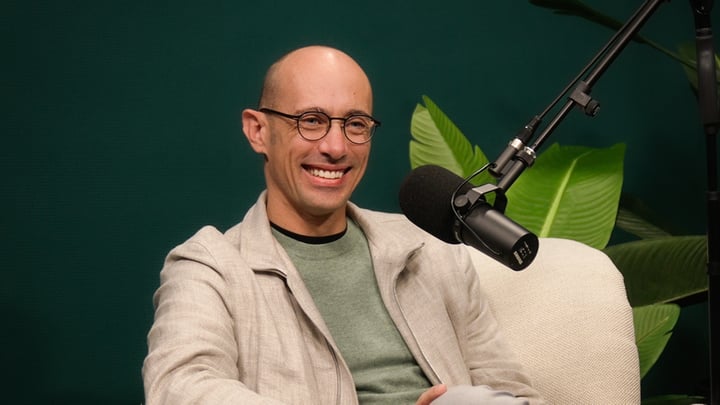
Andrew Ross Sorkin does the work of about five people. He founded and writes the DealBook newsletter for the New York Times. He hosts Squawk Box on CNBC every morning at 6am. He runs the DealBook Summit, which has become the premier annual interview event across business, policy, and technology. He co-created the TV show Billions. He wrote the definitive account of the 2008 financial crisis, "Too Big to Fail", and now he's written "1929," a 600-page epic about the greatest crash in Wall Street history. So how does he actually do all of this?
Today we sit down with Andrew to answer exactly that question. We dive into his philosophy on interviewing, his start as a teenage freelancer at the New York Times, how he built DealBook from a daily column into a media empire, and his actual daily routine that somehow fits all of this into 24 hours!
Tobi is one of the most thoughtful people in the technology industry. He's also one of the very few people who started as a programmer -- just trying to solve his own problem -- and still runs his company as CEO today even as it approaches a $200B market cap. Tobi has done this in two big ways: first, a willingness throw away his past beliefs in the face of new data, growing into the leader the company needed. And second, by remaining a close observer (and participant!) in how new technology emerges that changes what is possible.
Today we talk with him about both. The first half of the episode is about what has changed for him in the AI era. How he spends his time with AI throughout the day, how he thinks about what AI unlocks philosophically, and what he thinks the impact will be on all of us and what we build. The second half is more about Shopify. How he dealt mentally with the explosion in stock price in 2021 from a 20x revenue multiple to a 70x revenue multiple. And then, what he subsequently did when it all came crashing down. We also talk with him about the leadership and product principles that he's employed to steadily grow the company's revenues to an all-time high today.
Is AI just better software? Or something completely different that requires a new paradigm to understand? Today we sit down with Bret Taylor and Clay Bavor, two of the best product builders in the world to tackle that question. Bret and Clay are the co-founders of the AI company Sierra.
Brett's resume reads like a greatest hits of Silicon Valley: co-creator of Google Maps, founder of FriendFeed (acquired by Facebook where he became CTO), founder of Quip (acquired by Salesforce where he became co-CEO), former Chairman of the Board at Twitter, and current Chairman of the Board at OpenAI. Clay spent 18+ years at Google, starting as an APM alongside Brett and eventually running product for Gmail, Drive, Docs (all of Google Workspace), Google Labs, and the company's AR/VR efforts.
In addition to AI, today’s conversation has some great tech industry history discussion and old Google stories, perfect to tide us all over between Google Part I and Part II!
Additional Topics:
The Savannah Bananas have created a whole new sport. It’s baseball, but it’s not. It’s fast-paced, exciting, and incredibly entertaining. For example, if you're batting, and you step out of the batter’s box... it’s a strike. If you bunt, you’re out. If a fan catches a foul ball… you’re also out. Games are capped at two hours with no exceptions. It’s sacrilegious to traditional baseball fans everywhere. But it’s hard to argue with their numbers: they have 3.2 million fans on a waiting list to see them and have been selling out 80,000-seat football stadiums over the past few months!
Today, we sit down with Jesse Cole, founder of the Savannah Bananas and creator of Banana Ball. We unpack the whole story, staring with a failing college summer league team, an air mattress, and a $30 weekly grocery budget. But these days... it's safe to say that Jesse and his wife don’t have to sleep on an air mattress anymore! And they have built the business in their own way, fully under their control, and uniquely “fans first”. They have a unique all-in ticketing model, where your game ticket gets you full access to food along with your seat. There are no ads or sponsorships. There are no ticket fees or middlemen. And in fact, Jesse and crew will even pay the sales tax on your ticket for you! Jesse is just totally obsessed with delighting fans, controlling the end-to-end experience, and thinking long term… even if it means leaving (a lot) of money on the table today.
This may be our most fun ACQ2 (or Acquired!) episode ever. Enjoy!

On our AWS episode, we talked briefly about the next chapter of cloud: data warehouses. But what makes them so powerful? Why do enterprises rely on them? And how will cloud customers collaborate on data stored in multiple clouds?
We sit down with Kamakshi Sivaramakrishnan, the co-founder and CEO of Samooha, a new company backed by Altimeter and Snowflake Ventures to tackle the problem of secure data sharing and collaboration in the cloud. Kamakshi has an impressive background to speak to this problem, having been a part of AdMob (sold to Google), and the founder/CEO of Drawbridge, which sold to LinkedIn. She then went on to work in Microsoft's Office of the CTO, where she obviously had a lot of experience understanding the needs of cloud customers.
If you want a better understanding of how enterprises use the cloud, multi-cloud architecture, and how security and privacy works with customer data at scale, this episode is for you!
Statsig CEO and former Facebook VP Vijaye Raji joins us to discuss democratizing the tools of big tech. Before starting Statsig, Vijaye spent 10 years at Facebook where he led the development of their mobile ad product (yes — THAT mobile ad product that’s the core of FB today).
We talk all about about Facebook’s early days in mobile, and the internal building and shipping process that let them continuously experiment and roll out features out to billions of users, which Statsig is now bringing to engineering and product teams everywhere. This episode is a must-listen for product builders at all stages!
Listen in any podcast player.
We sit down with Altimeter Capital’s head of Capital Formation Meghan Reynolds (who previously was TPG’s global co-head of Capital Formation for 10 years) to talk about everything that goes into the LP - GP relationship at venture funds. We cover how (and why) to think strategically about Capital Formation, why it should be about so much more the just investor relations / fundraising, and also why and how it’s going to change dramatically over the next decade. This was a GREAT conversation, and very relevant for GPs, LPs, and also company founders and employees heading into 2023 and post zero-interest-rate capital markets.
Listen in any podcast player.
Links:
The Acquired community's own Austin Federa joins us for a 101 primer on how to self-custody your crypto assets, and why it’s the only truly safe way to hold them. Given all the current turmoil (and fraud) in crypto-land, we were thinking “how could we do something to help the Acquired community right now”, and Austin gave us the perfect idea. In addition to running the #digital-assets channel on the Acquired Slack, Austin is the head of communications at the Solana Foundation and has plenty of hard-won experience through previous crypto cycles and implosions. This episode covers both the nuts and bolts of a “how-to” guide, as well as a more philosophical discussion of self-custody across asset classes, and the practicalities and convenience tradeoffs involved.
We had the rare opportunity to interview Jay Hoag, cofounder of the first tech crossover investing firm, TCV, at TCV’s Engage Summit in Half Moon Bay earlier this fall. Jay and Rick Kimball started TCV back in 1995 and have been part of the private-to-public journeys of storied companies like Netflix (which Jay shares some great war stories about on this episode), Spotify, Zillow, Expedia, Facebook, Airbnb, Peloton and many others. Jay and TCV were kind enough to let us release the conversation as an ACQ2 episode, and we’re excited to share it with all of you. We cover the firm’s history, how companies should calibrate the magnitude of their future-looking product investments (a topic we didn’t realize would end up being so timely) and perhaps most importantly, pivotal moments where now seemingly unstoppable companies almost died amidst big macroeconomic changes. We hope you enjoy!
We sit down with Brian O’Malley of Forerunner Ventures to talk about where in the cycle we are right now for consumer investing. We touch on the macro environment (obviously!), but also how to navigate between and around the current generation of platform incumbents, and where the next breakthrough consumer technology companies might come from. And in true Acquired Playbook fashion we talk about the benefits of focusing on niches — and how on the internet they can expand ever bigger than you might initially imagine!
Links:
The CEO of Mutiny, Jaleh Rezaei, joins us to talk about the playbook to profitably grow a B2B company — something particularly useful for founders in 2022! Jaleh was Gusto’s first head of marketing (and before that worked at VMware and Sequoia), and has since gone on to build Mutiny, which helps B2B companies dynamically optimize their websites for conversion and has raised over $70m from Sequoia, Insight, Tiger and other great investors.
Links:
Kindergarten Ventures LP (and fellow podcast host over at Unlimited Partners) Thomas McGannon interviews David about Kindergarten’s investment thesis for their recent large investment in Vanta. Along the way they discuss KV’s overall strategy, how it fits into Acquired, and why it’s “accidentally” become the best answer David has ever had to “why should a great founder take my capital?”
Links:
We sit down with Kettle cofounder — and David’s Kindergarten Ventures partner — Nat Manning to discuss the fascinating world of reinsurance, risk and climate. We couldn’t think of a better and more appropriate conversation to have on ACQ2, and this was an absolute blast. Tune in and enjoy!
Links:
We sit down with long (long!) time Acquired community member Austin Federa to discuss the current state of crypto and Web3. By day Austin is the head of marketing & communications at the Solana Foundation, where he was one of the earliest employees. But many of you also know Austin from his "night job" as the founder and lead of the #digital-assets channel in the Acquired Slack, where he does an incredible job curating some of the best and most accessible digital asset discussion on the internet. No matter whether you're already deep in Web3, curious but sitting on the sidelines, or a diehard crypto skeptic, this episode is well worth listening to and learning from!
What does a $200 million+ acquisition look like up close? How much time, focus, and communication happens between the first conversation and closing the deal? And when do the CEOs of each company just need to use the "red phone" and have a direct conversation without the 86(!) lawyers in the room?
We sit down with ProfitWell founder and CEO Patrick Campbell to answer it all, centering on ProfitWell's recent acquisition by Paddle. And incredibly, Patrick built and scaled the SaaS company without taking a single dollar of investment! If you're running a company that may one day need to navigate an acquisition (or just curious), tune in!
Links:
- Our Previous Episode with Patrick, a Masterclass on Pricing
- The Documentary: "We Sign Tomorrow?"
We sit down with TrovaTrip co-founders Nick Poggi and Lauren Schneider to talk about travel for the creator economy. This one is very close to home since Ben is on their board!
TrovaTrip is a marketplace that enables creators to easily plan trips to places around the world with their audiences. It's a whole new way for people to travel, with other like-minded people who share the same passions and communities. We talk with them about growing from a bootstrapped business to over 10,000 travelers booked, growing a travel business during the pandemic, and dive deep on the power of choosing a business model with favorable cashflow dynamics. Tune in!
We dropped by Vanta's all-hands in SF a few weeks ago for Christina to interview us for a change! We decided to turn the mics on and record it as an LP episode. We discussed lessons learned from building Acquired, the shape of the show's growth trajectory, how we think about the business, and dive into our own origin story/